Search 4,000 EV News articles

Wednesday, December 16, 2015

Tesla Model S is the Fastest Selling Electric Vehicle in NSW

Nissan is celebrating 5 years of the LEAF and Tesla Australia is celebrating 1 year in Australia. With the upcoming New year I thought it would be good to look back at the history of electric vehicles in NSW.

Growth

Lets look at growth in NSW Tesla don’t share their data with VFACTS, the industry body for new car sales reporting but RMS/RTA do keep registration statistics on how many cars of a particular brand are sold and what type of fuel they use. Using those statistics we can look at how many “pure electric” vehicles are on the road in NSW. The first production EV was the Mitsubishi i-MiEV launched in 2010 before then the 44 or so vehicles registered as electric with the RTA/RMS where most likely conversions.

What’s included in this count? RMS count petrol/electrics separately so this count doesn’t include plug-in hybrids like the Outlander PHEV, Holden Volt or BMW i3 Rex. What it does include is listed below with their official release dates.

Release Dates :

  • 2010 August Mitsubishi i-MiEV (Limited selective client release)
  • 2011 August Mitsubishi i-MiEV (source: MMAL Press release )
  • 2012 June Nissan LEAF (source: Nissan Press release )
  • 2014 December BMW i3 (excluding the REX hybrid version)
  • 2014 December Tesla Model S (The amount of registered Tesla’s is shown in red)

    Performance

    If we look at registrations since 3rd Quarter 2011 when electric vehicles began sales to the general public we see 524 registrations to date at a rate of 33 vehicles per quarter. Breaking it down further we see three district rates of registrations:

  • 2009-2011 – 7.8 Registrations per quarter.
  • 2012-2013 – 28.5 Registrations per quarter.
  • 2014 Q1-Q3 – 5.3 Registrations per quarter.
  • 2014 Q3-2015 Q3 – 66.5 Registrations per quarter.

    With the release of Tesla Model S we see Tesla alone contribute 52.5 Registrations per quarter, all other makes and models only managing 14 per quarter since 2014. The best performing quarter is the fourth quarter of 2014 with 87 registrations 65 Tesla 22 others. The worst performing quarter since the release of the i-MiEV first quarter of 2014 with only 4.

    Insights

    Tesla has landed on our shores and has been welcomed with open arms with the fastest “selling” electric vehicle in NSW. Nissan/Mitsubishi was a steady seller until 2014. However Nissan have not released an updated model since 2012 in Australia, maybe it’s time for a new model LEAF that sell overseas. Mitsubishi also no longer have i-MiEV at dealerships, concentrating their efforts on the Outlander PHEV.

    In terms of charging standards we’ve seen Tesla enter with their own version of a type 2 socket which is Mennekes type 2 compatible. Where as everyone else has been type 1 J1772 it’s a bit hard to gauge a direction while 30% of pure electric vehicles are Tesla we don’t have accurate numbers for other type 1 J1772 plug-in vehicles like the Holden volt, Audi a3 e-tron Mitsubishi Outlander PHEV, BMW i3 REX, BMW i8 and the hybrid offerings from Porsche.

    Over the last year we’ve seen a significant growth in electric vehicles, installing a type 2 socket universal charging station to suit all vehicles at your office, shop, restaurant, church or sports field will further enhance the growth of electric vehicles.

    Source: Recharging NSW

    reproduced with permission

  • Wednesday, April 8, 2015

    Mitsubishi to Launch Outlander Sport Plug-In Hybrid in 2016

    Mitsubishi is planning to bring to the US a plug-in hybrid version of its smaller Outlander Sport model – a segment of the market where previous to this week no automaker offered any hybrid, but to which both Toyota and Nissan have now thrown their hat in the ring.

    Mitsubishi says of its baby PHEV: 'The system is estimated to achieve very low CO2 emissions of below 40g/km while also delivering gutsy and smooth performance with its 163bhp electric motor.' It adds that it is developing plug-in electric hybrid systems best suited to each model in its line-up with a view to introducing them in the near future.

    "We are committed to huge investments in capital as well as huge investments in R&D," Mitsubishi's Don Swearingen, executive vice president for sales and fixed operations at Mitsubishi Motors North America said.

    "With the way our company was structured and the financial conditions that we were in, we had to get ourselves (back) on solid ground" before making this commitment,

    Friday, October 17, 2014

    Fully Charged - Mitsubishi Outlander PHEV [VIDEO]

    Robert Llewellyn takes the Mitsubishi Outlander PHEV (Plug in Hybrid Electric Vehicle) for a 500+ mile test drive.

    "A really pleasant car to drive, enormous inside, smooth, quiet and very comfortable and it costs the same as the diesel model."

    Friday, October 3, 2014

    Outlander PHEV Concept-S Plug-In Hybrid Electric SUV [VIDEO]

    Mitsubishi has introduced the Outlander PHEV Concept-S this week at the Paris Motor Show.

    Likely previewing an upcoming facelift for the mid-size SUV, the concept adopts a fresh front fascia with an "X" layout and chrome accents along with LED headlights & fog lights. There's also a different grille while on the inside it has a black & burgundy color scheme with a black wood grain trim with silver accents. The center console has been designed with influences from the Japanese traditional black lacquered boxes and the cabin also comes with hand-stitched soft leather upholstery.

    The Mitsubishi Outlander PHEV Concept-S is 4760mm long, 1840mm wide, 1700mm tall and has a wheelbase that spans at 2670mm. Power is provided by a plug-in hybrid system encompassing a four-cylinder 2.0-liter gasoline engine teamed up with two electric motors and a 12 kWh lithium-ion battery pack.

    Just like the production Outlander PHEV, the concept can provide a total range of 547 miles (880 km) and working solely on electric power it will do 34 miles (55 km) before running out of juice. When used as a hybrid, the vehicle is capable of returning an outstanding 143.5 mpg US (172.3 mpg UK or 1.6 liters / 100 km).

    Thursday, September 25, 2014

    Mitsubishi to reveal Outlander PHEV Concept-S in Paris

    Mitsubishi Motors Corporation (MMC) will present the world debut of the Outlander PHEV Concept-S at the 2014 Paris Motor Show. The Outlander PHEV Concept-S is a concept model based on the Outlander PHEV 4WD SUV plug-in hybrid vehicle.

    The Outlander PHEV Concept-S is a concept model presenting a special design package for the production Outlander PHEV. The exterior and interior design are created under "Sporty and Sophisticated" design theme. The design expresses driving pleasure by delivering powerful and agile driving performance as well as quiet, advanced and high quality driving performance provided by its Twin Motor 4WD and Plug-in Hybrid EV System.

    Exterior
    Meant to symbolize the functionality and reassuring safety inherent to Mitsubishi Motors' SUVs, the front end design shields the Three-Diamond mark with bold chromed accent moldings on either side - a three dimensional effect - in a further suggestion of motion. Wraparound headlamps contribute themselves to a sense of dynamism sweeping gently up and outwards. This "protective theme" continues at the rear where similar symbolic chrome accents – topped by elongated combination lamps - run from tailgate to wings meant to express dynamic and innovative styling as if bracing the vehicle for better safety. The body color uses a brilliant "Platinum White" with glass flake finish.

    Interior
    Contrary to the sparkling exterior design, the "Black & Burgundy" color scheme interior design offers a refined quality passenger compartment. In particular, Concept-S' interior design makes use of painstakingly executed detailing to express precision, quality, craftsmanship and sophistication such as:

  • Black woodgrain trim with silver accent
  • The center console designed inspired by Japanese traditional black lacquered boxes
  • Soft fine leather, hand-stitched by craftsmen selected for the seat upholstery

    Furthermore, the seat upholstery forms a three-dimensional surface with horizontally-ribbed cushioning providing superior fit, while the use of trimming lines is formed so as to gently follow the body contours holding occupants snugly in place.

    Silver accents of the trimming lines, curving around the seat, further enhance the perceived quality of the interior.

    Main Specifications
    Overall length (mm)
    4,760
    Overall Width (mm)
    1,840
    Overall height (mm)
    1,700
    Wheelbase (mm)
    2,670
    Occupants
    5
    Powertrain
    Plug-in Hybrid EV System
    (2 permanent magnet synchronous motors, Lithimun-ion battery (12kWh),
    2.0-liter 4-cyl. DOHC MIVEC gasoline engine)
    Drivetrain
    Twin Motor 4WD

  • Tuesday, August 26, 2014

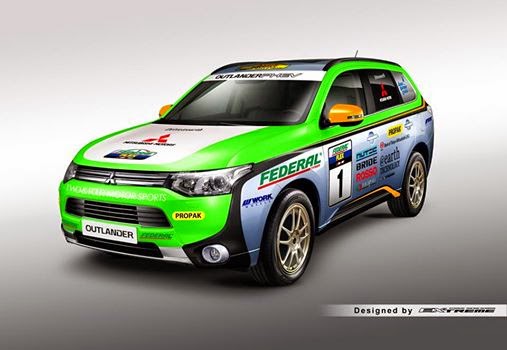
    Mitsubishi Outlander PHEV to enter 2014 Australian Safari

    Mitsubishi’s top selling Outlander PHEV plug-in hybrid electric vehicle is set to tackle a new frontier when it takes on one of the toughest off-road events in outback Australia next month.

    With technical support from Mitsubishi Motors Australia (MMAL), Team Mitsubishi Ralliart Australia (TMR Australia) will enter a plug-in hybrid Outlander PHEV in the iconic Australasian Safari, which takes place in Western Australia from 19-27 September.

    It will be the first plug-in hybrid four-wheel drive officially entered in an Australian motorsport event – including the Safari, which is considered one of the most demanding off-road endurance rallies in Australia.

    Experienced local driver and co-driver team of Steve Glenney and Bernie Webb will put the TMR Australia petrol electric Outlander PHEV through its paces during the nine-day outback event.

    The Outlander PHEV will compete in class A1 for production vehicles, in a category specially created for hybrid or dual powered vehicles.

    TMR Australia’s Australasian Safari entry marks the third international off-road rally outing for an Outlander PHEV since its launch in late 2012. Previously, the Outlander PHEV’s all-terrain performance and durability have been tested in the Thailand, Cambodia Asia Cross Country Rally, which the Mitsubishi SUV successfully completed in 2013 and 2014.

    TMR Australia Outlander PHEV Safari Team Principal Alan Heaphy said the Australasian Safari is a challenging event that demands stamina and endurance from competitors and vehicles alike.

    “We’re very excited about building the first plug-in hybrid to compete in the Australasian Safari,” he said.

    “The Outlander PHEV showcases the latest Mitsubishi hybrid and four-wheel drive technology, making it an ideal platform for an entry in the Australasian Safari.

    “From our long-term experience working with Mitsubishi products, the quality of engineering and technology is a good match for motorsport, and we’re looking forward to proving the Outlander PHEV’s durability and technology in genuine off-road conditions.”

    Competing in Australasian Safari production class A1, the Outlander PHEV will be built to meet FIA specification with only minor modifications made for durability and safety.

    To help it withstand the punishing conditions, the Outlander PHEV will have extra underbody and frontal protection, reinforced suspension arms and strut towers along with competition brake pads, rally tyres and springs with adjustable dampers for added strength and durability.

    The Mitsubishi Outlander PHEV is the world’s first plug-in hybrid SUV. It uses Mitsubishi Motors’ advanced electric vehicle technology by combining a 2.0L MIVEC petrol engine with high output 60kW twin front and rear motors, high capacity 12kWh drive battery and regenerative braking system for maximum efficiency and performance.

    Mitsubishi Motor Company will support the TMR Australia Outlander PHEV Safari entry by sending three plug-in hybrid specialist engineers to Western Australia for technical assistance during the gruelling seven day event, which will cover more than 2,500 competitive kilometres through sand, salt plains, dry river beds and rugged desert tracks.

    The 2014 Australasian Safari concludes in Kalbarri – 600 kilometres north of Perth – on Saturday 27 September.

    Thursday, August 7, 2014

    Mitsubishi Outlander PHEV Best Seller on UK Gov Grant Scheme

    The Outlander PHEV is helping Mitsubishi sales success in the UK.

    In July Outlander PHEV outsold all other vehicles which qualify for the governments Plug-in Car Grant, accounting for 43% of successful applications. This car has received huge levels of public interest, driven by the vehicle’s outstanding fuel consumption of 148 MPG and low emission credentials – 44g/km.

    Toby Marshall, Director of Sales & Marketing for Mitsubishi Motors in the UK, said: “Now that the sales figures are in for July, it is clear to see we have made significant progress so far this year. The addition of the game-changing Outlander PHEV to our vehicle line-up has helped boost Mitsubishi brand awareness, increasing sales of all models in our range.”

    Wednesday, August 6, 2014

    Nissan, Mitsubishi to launch low-cost electric car by 2016

    Nissan Motor and Mitsubishi Motors will work together to develop a minicar-based electric vehicle, aiming to release a new model in fiscal 2016 at the lowest price among major automakers.

    The carmakers have set up a 50-50 joint venture to pursue development.

    Nissan, which released the Leaf electric car in 2010, is the world's largest manufacturer of electric vehicles, with global sales of at least 124,000 units. Mitsubishi has a track record in this area as well, including the minicar-based i-MiEV released in 2009. They plan to co-produce the new car and work together to procure such key components as lithium-ion batteries.

    The i-MiEV is the cheapest electric passenger car on the Japanese market, starting at $26,440. When government subsidies of up to $7,760 are included, it can be purchased for as little as $18,680.

    By basing the new EV on a minicar, Nissan and Mitsubishi expect to sell it for around $15,000 including subsidies, the lowest price among major automakers and similar to gas-fueled compacts.

    Wednesday, July 9, 2014

    Record Breaking Mitsubishi Electric Vehicle Run at Pikes Peak [VIDEO]

    Record Breaking Mitsubishi Electric Vehicle Run at Pikes Peak by Greg Tracy.

    Tracy climbed Pikes Peak in the Mitsubishi I-MiEV Evolution III and shatters Monster Tajima's 2013 Electric Modified Class record by 38 seconds with a 09.08.188 record time.

    Greg Tracy came in 2nd overall beating everyone in the competition except for overall winner Romain Dumas in his Honda powered 2013 Norm racer.

    Saturday, July 5, 2014

    Mitsubishi Outlander PHEV Plugin hybrid Test Drive [VIDEO]

    Mitsubishi Australia were kind enough to loan EV News an Outlander PHEV for a week long test drive and we're not surprised it is already the best selling plug-in EV in Europe.

    The Mitsubishi Outlander PHEV is the first 4x4 SUV to combine 'series' and 'parallel' hybrid systems. It has all the benefits of a plug-in electric car with a part-time duty cycle 87 kw 2.0 L 4 cylinder MIVEC (Mitsubishi Innovative Valve timing Electronic Control system) petrol engine that can run in either series hybrid mode, where it is used to top up the 12 kWh lithium ion battery mounted under the cabin, and/or can also runs in parallel mode to drive the front wheels.

    The electric powertrain is based on 2x 60 kw / 166 Nm BLDC permanent magnet synchronous motors that run on up to 300 volts. It's a bit like having an iMiEV motor on each axle. Given the 1810 kg curb weight, EV mode acceleration is reasonable, but applying anything more than half throttle activates the ICE to assist. In this parallel mode the PHEV has a combined maximum output of 207 kw available for hard acceleration, which 'feels' like a V6.

    Mitsubishi engineers have done an excellent job on NVH (noise, vibration and hashness) for the part-time duty cycle ICE (internal combustion engine) in the Outlander PHEV. Unlike the Holden Volt we drove last year where the ICE became fairly annoying after a few hours in the car, the ICE powertrain in the PHEV is so quiet that, without the assistance of the LCD 'energy use' dash display graphic, it's hard to tell whether the ICE is actually running or not!

    The official ADR fuel economy rating for the PHEV is 1.9L/100km, with a maximum range of 824 kilometers from it's 45 liter fuel tank. I had originally planned to drive the PHEV to Melbourne (1,800 km round trip) to test highway range and the adaptive cruise control system (more on that later) but for business reasons the trip was postponed. Instead, during the 7 days I had the PHEV, I never needed to lift the fuel filler flap even once and returned the vehicle with more than 100 km range still indicated on the dash having covered 700 km of urban driving.

    The vehicle was plugged in each night so we started each day with a full battery. The 12 kWh battery gives an EV mode range of approx 50 km. The PHEV provides a couple of options for managing your charge via two centre console mounted buttons. The 'CHRG' button allows the driver to manually turn on the ICE to charge the battery while the 'SAVE' button conserves battery charge and engages the ICE to drive the Outlander PHEV like a regular front wheel drive petrol vehicle. We were still experimenting with the save mode when we had to return the vehicle.

    At highway speeds, aerodynamic load is at it's maximum and brake regeneration on expressways is minimal. Also, a electric cars battery contains a relatively small amount of energy (12 kWh) compared to a regular fuel tank (45 L x 9 kWh/L = 405 kWh). In an effort to make the most efficient use of the available stored electrical energy, we experimented with using 'Save' mode on any steady-state motorway with a posted speed limit of 100 km or more in an effort to save the battery for lower speed urban roads where brake regeneration can be maximised and losses such as aero resistance are minimal.

    Unfortunately it wasn't a very scientific experiment so I can't provide any energy use figures. Even without using save mode at all the PHEV still achieves minimal fuel burn using it's own internal pre-programmed strategy of running the ICE in parallel mode at highway speeds so perhaps it would take longer than a 700 km test drive to get the most out of these manually operated features.

    All Mitsubishi Outlander PHEV press cars are the top-of-the-range Aspire model which comes with a feature that seems perfectly suited to an electric powertrain, adaptive cruise control. As an EV powertrain can brake and accelerate with a single input from the throttle pedal, this allows seamless control of a vehicles variable speed relative to other traffic.

    Adaptive Cruise Control was my favorite feature on the car and was turned on at every opportunity. In traffic it takes over everything but the steering. In built-up heavy traffic with speeds as low as 1 km/h the system will slow and accelerate in response to the traffic ahead without any driver input. In stop-start traffic the system can bring the vehicle to a complete stop, only signalling to the driver to push the brake pedal once the vehicle is stationary. The vehicle will not move away from a dead stop, but cruise can be resumed once over 10 km/h.

    It was not uncommon to have the cruise control set to 80 km/h while only seeing 50 km/h on the speedo as the car responded to traffic. The driver can adjust the distance to the car ahead in three steps with a a steering wheel adjustable push-button. In addition this distance automatically adjusts according to speed, with the gap to the car ahead increasing at higher speeds.

    The system also handles lane changing fairly well. When the driver changes lanes to go around a slower vehicle the system will respond to the clear lane ahead and accelerate to the set speed. The driver can also momentarily over-ride the system with throttle input to accelerate into a gap while lane changing and the cruise control will resume at the set speed once you lift off the throttle pedal.

    One thing we were curious about was what the brake lights were doing in adaptive cruise mode. Apparently the low-speed auto brake system on the Ford Focus strobes the brake lights when active, but we were unable to confirm what was happening on the back of the PHEV in this mode?

    As with most hybrids which mix regenerative and friction braking, the PHEV runs a brake-by-wire system with a servo operated hydraulic brake master cylinder. This enables the cruise control to apply friction brakes at very low speed to bring the vehicle to a complete stop. With Adaptive cruise control, driving in heavy urban traffic almost becomes relaxing! I honestly think the combination of regenerative braking and cruise control is the single best feature of the car and given the fact ABS and stability control are now mandatory on new cars, it seems only a matter of time before adaptive cruise control and autonomous braking also become mandatory features.

    Speaking of stability control, the Outlander PHEV comes with Mitsubishi's Active Yaw Control (AYC) and Super All Wheel Drive Control (S-AWC). These systems were first developed for the rally homologation special Mitsubishi Lancer Evo. Given the SUV's high centre of gravity this is probably a very handy feature to have although there was no way I intended to push this vehicle to the limit to test it out. Perhaps the PHEV powertrain will soon be seen in something closer to the ground like the XR-PHEV EVO images recently released, then AYC and S-AWC could be actively engaged on winding country roads for purely entertainment value without the risk of tipping the vehicle over.

    With a list price of $47,490 for the standard Outlander PHEV and $52,490 for the Aspire, it's little surprise the PHEV has shot to #1 plug-in on debut with 99% of all Outlanders sold being PHEV in several markets around the world.

    (EU's best selling EVs Q1-Q3 2014)

    Monday, June 30, 2014

    Mitsubishi MiEV Evolution III Wins Pikes Peak Electric Division & 2nd Outright

    Mitsubishi Motors Corporation (MMC) entered two MiEV Evolution III all-electric racecars, which combine the best of MMC's electric vehicle (EV) and four-wheel drive control technologies, in the Electric Modified Division of the 2014 edition of the world-famous Pikes Peak International Hill Climb (Pikes Peak, June 23 to June 29) in Colorado, United States.

    Race Day was held on Sunday June 29 and after posting the fastest time of 9 minutes 08 seconds 188, Greg Tracy won the Electric Modified Division honors and 2nd overall. Meanwhile, Hiroshi Masuoka set a time of 9 minutes 12 seconds 204, finishing 2nd in the division and 3rd overall, dominating the Electric Modified Division. These Race Day results and the performance of the cars during the event speak volumes about the advanced level of MMC’s EV and four-wheel drive control technologies.

    The race starts at an elevation of 2,862 meters and takes competitors through 156 corners on a 20 km course to the finish on the 4,301 meter summit of Pikes Peak. With an elevation difference of 1,439 meters, atmospheric pressure, temperature, weather and other conditions vary significantly between the start and finish. A feature of the race course is that it is split into three major sections: Bottom at the foot of the mountain, Middle and then Upper near the summit.

    Lined by coniferous trees, the Bottom section starts with its rhythmical series of mid- to high-speed corners but all of a sudden the drivers hit a series of much tighter and difficult turns which demand the utmost care and concentration.

    The Middle section is distinguished by some spectacular scenery with oddly-shaped rocks closely bordering the road. This is a very technical section as shortly after the start a series of tight hairpin bends demand precise handling as the car races along the steeply ascending road.

    The Upper section is a very high-speed course taking competitors through many fast corners between craggy rocks and boulders. With little guard railing at the side of the road, this very difficult section brings with it the risk of plunging over the edge should the car slide off the tarmac. This is why the highest levels of vehicle stability are required over the high-speed parts of the section. At 4,301 meters, the mountain summit is higher than Mt. Fuji and the thin air means that cars powered by internal combustion engines lose power the higher up they go. Electrically powered cars, however, are unaffected by the thin air and so this could prove the key section in setting a really fast overall race time.

    PositionDriverVehicleTime
    1Greg TracyMiEV Evolution III9:08.188
    2Hiroshi MasuokaMiEV Evolution III9:12.204
    3Tajima NobuhiroE-RUNNER Pikes Peak Special9:43.900
    4Ikuo HanawaHER-0212:18.019
    5Janis Horeliks2014 Tesla Roadster 36012:57.536

    Monday, June 23, 2014

    Outlander PHEV to Tackle Asia Cross Country Rally 2014

    Mitsubishi Motors Corporation (MMC) announces that it will dispatch a team of technical support engineers for an Outlander PHEV entered in the T1.3 4x4 Electric class of the grueling 2,200km FIA-certified Asia Cross Country Rally 2014 (AXCR) from August 9 through 15, to be run from Thailand to Cambodia. The Two & Four Motor Sports rally team (Two & Four), headed by Kenji Ishida, will run an Outlander PHEV in the race for the second straight year. MMC engineers will provide Two & Four's team technical support for the plug-in hybrid four-wheel drive SUV for the duration of the rally. MMC will utilize valuable data and knowhow acquired by the technical support team in future vehicle development.

    The 19th edition of the AXCR will get under way with the Ceremonial Start in the Thai beach resort of Pattaya on Saturday August 9. The next day, August 10, sees the start of the rally proper as Leg 1 takes entrants from Pattaya to Sakaeo. On August 12, Leg 3 of the rally takes the competitors into Cambodia and past the World Heritage site of Angkor Wat. The event finishes in the Cambodian capital of Phnom Penh on Friday August 15. The AXCR covers a total distance of 2,200 km and offers a grueling test of all-terrain performance and durability as it requires competitors to conquer mountains, forests, swamps and river crossings.

    The Outlander PHEV rally car will use competition suspension and reinforced mountings to raise ground clearance and improve all-terrain performance over poor surfaces. The vehicle's S-AWC integrated vehicle dynamics control system will be tuned for competition use to deliver better traction. Other modifications include the fitting of a roll cage and underbody skid plate, the use of lighter engine hood, rear gate and interior parts, and additional sealing and a snorkel for water crossings.

    Friday, June 13, 2014

    Mitsubishi Outlander PHEV 830 KM Test Drive

    The Swiss Mitsubishi importer has demonstrated that a plug-in hybrid Mitsubishi Outlander PHEV can travel 830 km (518 miles) on a single tank of petrol.

    Mitsubishi Motors claims the plug-in hybrid Outlander PHEV has a range of 824 kilometers (512 Miles) in the combined hybrid mode. The Swiss Mitsubishi importer wanted to know whether this is feasible in practice so hired Felix Egolf - a pioneer in the field of ultra-efficient driving over long distances.

    Egolf departed on 12 May in a hybrid Outlander from the headquarters of the Swiss importer Härkingen and drove through Basel and the Vosges to Metz. From there he went through Luxembourg, Belgium and the Netherlands. End of the journey was the Dutch Mitsubishi importer in Amstelveen, where Egolf arrived on May 14. The route began in hilly area and 38 percent of the journey performed over highways.

    Upon arrival in Amstelveen odometer gave 729 kilometers and the remaining range was further than 90 kilometers. Egolf then drove the Outlander PHEV for a photoshoot to Amsterdam and Utrecht. The onboard computer gave a mileage of more than 830km to when the Outlander PHEV was refueled. For the first time since leaving again There was 45.14 liters of petrol in the tank, which means that consumption 5.44 liters per 100 km. The electricity was approximately 1 kWh/100 km.

    Mitsubishi Motors gives the official standard as a range of 824 kilometers. So that, in practice, is actually feasible. Of course, the driver must anticipate well in traffic and clever use of plug-in hybrid technique. That is, charge the battery while driving (CHARGE) or save energy (SAVE) and continuous regeneration system utilization, which produce electricity, which is stored in the battery during braking.

    EV News will be picking up a Mitsubishi Outlander PHEV for a test drive next week so perhaps we can also test the 800+ km range.

    Tuesday, June 3, 2014

    Mitsubishi enter two MiEV Evolution III racecars for 2014 Pikes Peak

    Mitsubishi Motors Corporation (MMC) will enter two MiEV Evolution III all-electric racecars in the 2014 edition of the world-famous Pikes Peak International Hill Climb (Pikes Peak, June 23 to June 29) in Colorado, United States. MMC will use two MiEV Evolution III all-electric racecars, which combine the best of MMC's electric vehicle and four-wheel drive control technologies. MMC has competed twice before in the Electric Division in 2012 and 2013, and now with the MiEV Evolution III, hopes to take its first victory, this time in the new Electric Modified Division.

    The MiEV Evolution III racecar is an improved and evolved version of last year's MiEV Evolution II. Main components including high-capacity battery, high-output electric motor and electric powered 4WD consisting of four electric motors have been retained with improvements made to give better motive and cornering performance. To reduce weight in the pipe-frame chassis the design has rationalized and some structural materials have been replaced.

    Total motor output of four motors has been boosted from 400 kW to 450 kW and to ensure all the extra power is put down on the road surface the tires have been uprated in size from 260/650-18 to 330/680-18. Accordingly downforce has been increased with a new carbon cowl design and with wind-tunnel optimization of the spoiler and other detail shapes. Evolutionary development of the S-AWC integrated vehicle dynamics control system has improved traction control performance and has reduced wheel slip by controlling vehicle attitude more precisely when near the limit of adhesion. These improvements allow the driver to extract the full potential of the racecar's awesome handling with confidence and reassurance.

    The race team will feature the same drivers as last year. One MiEV Evolution III will be driven by two-time Dakar Rally overall champion Hiroshi Masuoka, who piloted the MiEV Evolution II to second place honors in the Electric Division last year and also act as team captain. The second MiEV Evolution III will be piloted by Greg Tracy, six-time Pikes Peak motorcycle champion whom last year drove a MiEV Evolution II to third place in the Electric Division, his first time challenging the race on four wheels.

    The team technical director and chief mechanics are mainly all engineers in MMC's Development Engineering Office. Responsible for the maintenance of the racecars during the hill climb event, they will also be gathering data and knowhow which will be fed back into the advance development of MMC EV technologies, its S-AWC (Super All-Wheel Control) integrated vehicle dynamics control system and into the company's "e-EVOLUTION" - a fusion of electric motor drive and the S-AWC system.

    • MiEV Evolution III Specifications
    Length x Width x Height (mm)
    4,870 x 1,900 x 1,390
    Drivetrain
    4WD using 4 motors
    Motors
    (Made by Meidensha)
     
    Configuration
    4 (2 front, 2 rear)
    Maximum output (kW)
    450(112.5 kWx4 motors)
    Battery (Made by LEJ)
    Maximum capacity (kWh)
    50
    Chassis
    Steel pipe frame
    Cowl
    Carbon
    Suspension
    Front
    Double wishbone
    Rear
    Double wishbone
    Brakes
    (Made by ENDLESS)
    Front
    φ 380 mm disc with 6-pot calipers
    Rear
    φ 330 mm disc with 4-pot calipers
    Tires (Made by Dunlop)
    330 / 680-18
    Wheels(Made by Enkei)
    13J-18
    Control system(Made by dSPACE)
    Production i-MiEV ECU with MicroAutoBox*1
    *1: Programmable general-purpose ECU

    Friday, May 30, 2014

    Mitsubishi Concept XR-PHEV Evolution Vision Gran Turismo [VIDEO]

    Mitsubishi Motors, a company with a spectacular history in races like the Dakar Rally and World Rally Championships (WRC), has developed a special concept model for Vision Gran Turismo: This is the "Mitsubishi Concept XR-PHEV Evolution Vision Gran Turismo".

    In the development of this special concept model, Mitsubishi Motors introduced their design team, Advanced Vehicle Research and Development Group, and Aerodynamic Engineering Development Group into this project in the same process they would normally follow to plan and develop real motorsports vehicles.

    The styling of the car follows the basic concepts of the "MITSUBISHI Concept XR-PHEV" shown at the 2013 Tokyo Motor Show, while pouring in know-how gained from years of motorsports experience into its every detail. The result was the evolution of the concept into a stoic racing machine.

    The "Athlete Form" design concept was advanced further, emphasizing the driving features aggressively. The iconic front grill is a study of next generation Mitsubishi automobiles, and the shape that forms a wedge starting from the triple diamond mark is designed in the image of an athlete at crouching position on a starting line, evoking an intense image of tension and potential.

    Utilizing advanced development technology from the Plug-in Hybrid EV System, the spontaneous power of the motor and powerful torque of the engine is transmitted through an 8 speed dual clutch transmission (DCT) to drive the 4 wheels. It's overwhelming drive performance is controlled precisely with the S-AWC vehicle dynamics control system that distributes the drive force optimally to the 4 wheels, producing a handling characteristic that moves the car exactly as the driver desires.

    In addition, the carbon fiber reinforced plastic (CFRP) body reduces weight and greatly contributes to its agility, and the downforce produced by the aerodynamic form of the front and rear diffusers produces excellent cornering performance. The large diameter 20 inch aluminum wheels gives an impression of a tough suspension system, and the powerful appearance of the front and rear fenders is in the image of toned muscles of a powerful athlete.

    Thursday, April 10, 2014

    Mitsubishi Boss: Electric vehicles 'will beat petrol cars'

    Electric cars will be so affordable and have such a long range between re-charges that petrol cars will not be able to compete in the next generation of cars, Mitsubishi Motors Corporation president Osamu Masuko predicts.

    He said car and battery manufacturers were working on a seven-fold increase in battery capacity, increasing potential car driving ranges to more than 1000km, and major reductions to battery cost, one 20th of 2009 prices, that would drive the growth in electric cars.

    “Once these things are achieved, the petrol engine can't compete,” he said, adding: “In 10 years time, we might see a dramatic change.”

    He likened the rise of EVs to that of mobile phones, which had had a major impact on old style land-line telephones.

    “The world is changing, and it is definitely advancing, this battery technology,” he said.

    Mr Matsuko said the lithium-ion batteries for an electric car in 2009 cost as much as a Toyota Yaris, but had more than halved since.

    He said the Japanese government had a target to reduce the cost of batteries for cars to one 20th of the price of the 2009 variety, and with seven fold capacity.

    A 2009 electric car could travel 150km, he said, meaning the EV of the future should do more than 1000km.

    Mr Masuko said Mitsubishi would not be able to meet future fuel consumption and emissions regulations in the United States, Europe and China if it did not introduce electric and PHEV cars into its mix.

    He said car companies who failed to meet the regulations would have to pay penalties.

    “Paying penalities is not realistic,” he said.

    Mr Masuko said the fact that China – along with Bolivia and Chile – controlled one of the few sources of raw lithium for the making of current batteries was a concern, meaning the product was often used as a political bargaining tool.

    However, Kazakstan supplies were now coming on stream, reducing the risk of supply instability, he said.

    In the longer term, new battery substances possibly would further reduce the reliance on Chinese lithium, he said.

    Thursday, February 13, 2014

    Mitsubishi Develops EV Motor Drive with Built-in Silicon Carbide Inverter

    Mitsubishi Electric today announced it has developed a prototype electric vehicle (EV) motor drive system with a built-in silicon-carbide inverter. The EV motor drive system, the smallest of its kind, will enable manufacturers to develop EVs offering more passenger space and greater energy efficiency.

    Mitsubishi Electric plans to commercialize its new EV motor system after finalizing technologies for motor/inverter cooling, further downsizing and additional efficiency.

    Features

    1) Downsized motor drive system with integrated all silicon-carbide inverter
    -Achieves further system downsizing (14.1L, 60kW) with smaller motor resulting from improved thermal resistance between motor drive system and cooling system.
    -Equal to existing EV motors in power and volume, enabling replacement.
    2) Improved motor cooling performance
    -Integrates cooling system for motor and inverter thanks to cylindrical shape of power module accommodating parallel cooling ducts for motor and inverter.
    -Ensures stable cooling with even a low-power pump.

    Global demand for EVs and hybrid EVs (HEVs) has been growing in recent years, reflecting increasingly strict regulations for fuel efficiency and growing public interest in saving energy resources and reducing carbon dioxide emissions. As EVs and HEVs require relatively large spaces to accommodate their robust battery systems, there is a strong need to reduce the size and weight of motor systems and other equipment to ensure sufficient passenger space.

    Patents
    Pending patents for the technology announced in this news release number 94 in Japan and 29 abroad.

    Wednesday, December 18, 2013

    Netherlands: Mitsubishi Outlander PHEV #1 top seller on debut

    Retail sales of Mitsubishi's Outlander plug-in hybrid (PHEV) only commenced on 21 October in the Netherlands and it has immediately become the best selling car by a significant margin.

    2,736 plug-in Outlanders were sold in November (from a total of 2,766 Outlanders) accounting for a market share of 6.8%. The second highest selling car in the Netherlands for November was the Renault Mégane with 1,505.

    In EU guise the permanent electric 'Twin Motor 4WD' has a claimed maximum driving range of 824 km, electric only range of 52km, fuel consumption of 1.9l/100km, CO2 emissions of 44 g/km and a maximum speed of 170 km/h. Braked towing capacity is 1,500kg.

    The battery pack takes five hours to recharge using a standard European 230V/10A domestic supply but just 30 minutes (to 80%) using a quick charger to CHAdeMO standard.

    MMC insists the Outlander PHEV is neither "a mere adaptation of an existing internal combustion engine vehicle nor a dedicated plug-in hybrid EV system high tech showcase" but a further variant of the Outlander – alongside standard petrol and diesel versions "and developed as such from the start of the programme: a unique/no-compromise proposal in the industry and "the first self-power generating twin motor (permanent) 4WD PHEV".

    Mitsubishi said dealers had booked 10,000 signed orders across the continent since December 2012 and was "Much expected by dealers and customers in a region forecast to be its largest global market". The automaker expects EVs, hybrids and PHEVs to account for 20% of its production by 2020. If this trend of 99% of all Outlanders sold being PHEV continues, 20% might be a very conservative estimate.

    Friday, December 13, 2013

    Next Gen Lancer Evolution Hybrid to get different name

    This makes sense. Because the next generation Mitsubishi Lancer Evolution performance car is so different from the Evolution models that came before it, the Japanese automaker could assign it a completely different name, according to Motor Trend.

    While the next-gen car will still reportedly be turbocharged and all-wheel-drive, the engine will be downsized to a tuned version of the brand's 1.1-liter three-cylinder engine and will use electric motors on both front and rear axles similar to the Outlander PHEV's setup.

    Sources are hinting that those motors combined with Mitsubishi's next-gen S-AWC would give the Evo replacement handling capabilities beyond any past model. That is really saying something considering Mitsubishis's AYC (Acive Yaw Control) - an electronically controlled active rear differential - and S-AWC (Super All Wheel Control) - adds dynamic braking to AYC - already set the industry standard for performance-oriented active stability control systems.

    Wednesday, December 4, 2013

    Mitsubishi Drop 2014 i-MiEV Price to $12,995 in California

    Mitsubishi Motors North America have announced the 2014 Mitsubishi i-MiEV electric-powered production vehicle not only receives an expanded standard equipment package but also sees a considerable price reduction of $6,130 over the previous 2012 model year vehicle.

    The 2014 model year Mitsubishi i-MiEV ES model including CHAdeMO DC quick charge port, battery warming system and heated side view mirrors now starts at only $22,995 – an astonishing $6,130 price reduction from the previous generation. After factoring in the Federal tax credit of $7,500, the net MSRP of the 2014 Mitsubishi i-MiEV drops down to only $15,495.

    With a net MSRP of only $15,495 after factoring in the available EV federal tax credit of $7,500 and, for example, with the California state EV financial incentive of up to $2,500 (other generous financial incentives are available through numerous states and municipalities), residents in California can obtain the technologically-advanced 2014 Mitsubishi i-MiEV for as low as $12,995.

    To date, more than 30,000 Mitsubishi i-MiEV and i-MiEV-based production vehicles have been sold around the globe. In such diverse markets as the U.S., Europe and Asia, the i-MiEV has proven to be a safe, convenient and utterly reliable eco-friendly form of personal transportation in any market in which it is sold.