Search 4,000 EV News articles

Thursday, May 18, 2017

Renault & Qualcomm demonstrate dynamic wireless electric vehicle charging [VIDEO]

Renault today demonstrated dynamic wireless electric vehicle charging (DEVC), which allows vehicles to charge while driving. Renault has participated with Qualcomm Technologies and Vedecom in designing a DEVC system capable of charging an electric vehicle dynamically with a charge of up to 20 kilowatts at speeds up to, and in excess of, 100 kilometers per hour. The DEVC system has been designed to support real-world implementation of dynamic charging. The two Renault Kangoo Z.E. vehicles can pick up charge in both directions along the track.

The dynamic charging demonstrations took place at the 100-meter test track, built by Vedecom at Satory, Versailles, near Paris, within the FABRIC project. Qualcomm Technologies and Vedecom installed the primary part of the DEVC system in the test track, whilst Vedecom and Renault installed the secondary part onto two Renault Kangoos Z.E.. The DEVC system will shortly be handed over to Vedecom to perform tests for FABRIC. The tests will evaluate the operation and efficiency of energy transfer to the vehicles for a wide range of practical scenarios including vehicle identification and authorization on entering track, power level agreement between track and vehicle, speed and alignment of vehicle along track.

FABRIC is a €9 million project, mostly funded by the European Commission, addressing the technological feasibility, economic viability, and socio-environmental sustainability of wireless DEVC. The project began in January 2014 and will continue through December 2017, and is being undertaken by a consortium of 25 organizations from nine European countries, including automotive manufacturers, suppliers, service providers and research organizations from automotive, road and energy infrastructure domains. VEDECOM is one of the FABRIC collaborators and responsible for providing the demonstration of the charging solution at Satory using the Qualcomm Halo DEVC system. FABRIC’s main goal is to conduct feasibility analysis of wireless DEVC as a means of EV range extension.

“Our engineers and management have fully supported this project since the very beginning as it aligns perfectly with our focus on EVs, charging systems and mobility services,” says Luc Marbach, chief executive officer, VEDECOM. “We are a public-private partnership focused on pre-competitive research. The installation of one of the world’s first DEVC test platforms has provided us with a unique test facility and we look forward to expanding our expertise with the future testing.”

“Being part of this exciting project has enabled us to test and further research dynamic charging on our Kangoo Z.E. vehicles,” said Eric Feunteun, electric vehicle program director, Groupe Renault. “Our engineers have worked very closely with the Qualcomm Technologies and VEDECOM teams to complete the DEVC system integration demonstration as part of FABRIC. We see dynamic charging as a great vision to further enhance the ease of use of EVs, thus the accessibility of EVs for all.”

“We are inventors. We are WEVC. This dynamic charging demonstration is the embodiment of this,” said Steve Pazol, vice president and general manager, wireless charging, Qualcomm Incorporated. “I am immensely proud of what we have achieved. The combination of a global team of expert engineers and Qualcomm Halo technology, which covers all aspects of WEVC systems, irrespective of the magnetics used, has enabled us to really push the boundaries of the possible and outline our vision for future urban mobility.”

Wednesday, August 12, 2015

UK To Test Dynamic Wireless Charging For Electric Cars

Electric cars promise a greener future. But current battery technology limits how far you can go on a single charge. One possible workaround: “electric motorways”—roads that will charge your electric vehicle as you drive on it.

The UK government has already spent £200,000 ($300,000) investigating the feasibility of the idea, and is now setting up an 18-month off-road trial. If successful, it hopes to spend some of the £500 million budgeted for promoting the use of low-emission vehicles in the UK on creating these electric motorways.

Wireless charging technology already has been proven to work, both in phones and buses. South Korea has a 12-kilometer road that charge buses as they drive. The wireless technology that vehicles use is called SMFIR—it stands for shaped magnetic field in resonance—which involves the transfer of electric charge via magnetic fields that are generated and captured by coils installed in the road and car respectively.

The trials are the first of their kind and will test how the technology would work safely and effectively on the country’s motorways and major A roads, allowing drivers of ultra-low emission vehicles to travel long distances without needing to stop and charge the car’s battery.

The trials follow the completion of the feasibility study commissioned by Highways England into ‘dynamic wireless power transfer’ technologies.

Transport Minister Andrew Jones said:

The potential to recharge low emission vehicles on the move offers exciting possibilities. The government is already committing £500 million over the next five years to keep Britain at the forefront of this technology, which will help boost jobs and growth in the sector. As this study shows, we continue to explore options on how to improve journeys and make low-emission vehicles accessible to families and businesses.

Highways England Chief Highways Engineer Mike Wilson said:

Vehicle technologies are advancing at an ever increasing pace and we’re committed to supporting the growth of ultra-low emissions vehicles on our England’s motorways and major A roads.

The off road trials of wireless power technology will help to create a more sustainable road network for England and open up new opportunities for businesses that transport goods across the country.

The trials are expected to begin later this year following the completion of an ongoing procurement process. The trials will involve fitting vehicles with wireless technology and testing the equipment, installed underneath the road, to replicate motorway conditions. Full details of the trials will be publicised when a successful contractor has been appointed.

The trials are expected to last for approximately 18 months and, subject to the results, could be followed by on road trials.

As well as investigating the potential to install technology to wirelessly power ultra-low efficient vehicles, Highways England is also committed in the longer-term to installing plug-in charging points every 20 miles on the motorway network as part of the government’s Road Investment Strategy.

Tuesday, May 26, 2015

Daimler and Qualcomm to develop wireless charging for EVs

Daimler and telecommunications giant Qualcomm Technologies have announced a partnership to develop new wireless charging technologies for vehicles and phones.

The alliance will focus on “mobile technologies that enhance in-car experiences and vehicle performance,” as well as Qualcomm's Halo Wireless Electric Vehicle (WEVC) technology, with the overall aim of introducing an induction charging system into future Mercedes models.

Possible candidates for the technology could include the next-generation Mercedes-Benz S-Class, currently powered by a plug-in hybrid 3.0-litre twin-turbo V6, or even the small-sized B-Class Electric Drive.

Qualcomm, more widely known for producing a range of high-end smartphone processors, started developing the technology in 2011 and WEVC trials have been underway in the United Kingdom since 2012, with the technology working similarly to wireless phone charging.

A Vehicle Charging Unit (VCU) is installed in the floor of a garage or car park, which sends power wirelessly to a similar unit installed in the car, which sends power to the electric vehicle batteries.

Currently the technology only allows for stationary charging, but development is underway on dynamic charging that will work by installing multiple VCUs underneath roads capable of charging cars on the move.

The implementation of dynamic charging could cut the cost of electric vehicle manufacturing by reducing the need for large, range-extending batteries.

Additionally, Qualcomm's WiPower technology will be implemented to allow full wireless charging on a smaller scale, for compatible smartphones and tablets inside the vehicle.

Daimler AG group research and Mercedes development board member Thomas Weber said the new partnership will bear fruit for both companies.

“It's important that we remain on the cutting edge of technology and continue to deliver unparalleled experiences to our customers,” he said.

“With this in mind, we are eager to jointly explore possible fields of future cooperation with an internationally leading tech-firm like Qualcomm.”

Qualcomm Incorporated President Derek Aberle said integration of vehicle and mobile communications is the way of the future.

“The automobile has become an extension of always-on connectivity, and as such, we're continuously utilising our expertise in wireless mobility to deliver in-car experiences comparable to the ease and convenience of smartphones,” he said.

Last year, German luxury rival brand BMW announced it would team up with Daimler to research and explore the possibilities of similar technology, and Volvo has also previously revealed it is looking at the cordless tech and Toyota signed a deal with WiTricity in late 2013.

Californian Electric car specialist Tesla has also tested the potential of such systems, but dismissed them saying too much power was wasted in the transfer process.

Monday, March 23, 2015

UK Highways Agency commissions study into wireless power on roads

The Highways Agency has commissioned the Transport Research Laboratory (TRL) to undertake a feasibility study into the use of dynamic wireless power transfer (WPT) on Britain’s roads.

The Highways Angency wants to understand whether WPT can be used on motorways and major A roads, so it can prepare for and “potentially encourage” greater uptake of electric vehicles (EV).

Scheduled to report in spring this year, TRL will identify two near-market dynamic WPT technologies that could be suitable in future research and trials of the technology in the UK. The feasibility study will also consider “the requirements for integration with road infrastructure and maintenance, connection to the grid and requirements for provision of power and energy”.

In addition, TRL will look into approaches by vehicle manufacturers of integration into different classes of vehicle from cars to HGVs and busses, and investigate the viability of introducing the technology.

TRL said in a statement: “The purpose of the project is not to find an alternative to current plug-in charging infrastructure but rather to develop a comprehensive charging eco-system capable of delivering power to EVs via different methods. This is to facilitate greater and more flexible use of EVs in the UK, overcome range anxiety and allow switching to zero emission for vehicle types that have traditionally been accepted as not suitable for electrification, such as HGVs and coaches.”

Once the study is completed, TRL said it could be followed by a series of off-road “test track trials and accelerated pavement facility testing”.

Wednesday, August 27, 2014

London’s hybrid buses to wirelessly recharge at stops

Hybrid London buses that use batteries and a motor will now start recharging at stops, wirelessly. The inductive charge should mean the engine won't need to be used as much, or at all.

The inductive charging, built into the bus stops, will be trialled by TfL in four stops in east London from next year. The special Enviro400H E400 hybrid buses, with wireless charging capabilities, will run on route 69 between Canning Town and Walthamstow.

By keeping the batteries topped up the buses should be able to run longer in battery mode meaning lower running costs and less environmental damage. The journey should offer less vibrations and noise while travelling too. The trial should help enhance the electric bus offerings in London.

There are currently six pure electric buses being tested in London also. The Mayor of London wants the city to be the world's first Ultra Low Emission Zone by 2020. There are currently 800 hybrid buses operating in London with 1,700 expected in 2016 – making up 20 per cent of the total bus fleet.

Mike Weston, TfL’s Director of Buses, said: "We are continuing our assessment of new technology in the capital that can deliver genuine environmental benefits. This trial of extended range diesel electric hybrid buses, utilising the latest inductive charging technology, could be a step closer to getting even cleaner double deck buses on London’s streets. We will be closely monitoring the results of the trials, which may help us adopt this new cleaner technology more widely in London."

Thursday, August 21, 2014

BMW Formula E course cars to be equipped with Qualcomm wireless charging

The all-electric FIA Formula E Championship has today confirmed that its course cars for the inaugural season will be fitted with Qualcomm Halo™ wireless charging technology – an inductive charging system which allows the car’s battery to be charged without the use of cables.

With the final specification of car set to be announced shortly, the championship’s technical team took advantage of today’s final test at Donington Park to trial two BMW i8 and two BMW i3 models with the aim to evaluate them for the series’ official course cars. Earlier this year, the German marque was part of the Global Launch event of the Formula E in London.

All four BMWs have been specifically modified to meet FIA requirements, with one of the BMW i3 models featuring an inductive charging system from Qualcomm Incorporated (NASDAQ: QCOM), with the remaining three vehicles set to be adapted at a later stage. The technology has been developed by San Diego-based Qualcomm Incorporated, one of the official Founding and Technology Partners of the series and a global leader in 3G, 4G and next-generation wireless technologies. The Qualcomm Halo™ technology uses resonant magnetic induction to transfer energy between a ground-based pad and a charging pad fitted to the underside of the vehicle. The cars can then simply park over the base pad for charging to start automatically.

The chosen safety car – which will be officially entitled the Qualcomm Safety Car - will be driven by experienced driver Bruno Correia, whilst the medical and extraction cars will be overseen by FIA Medical Delegate Dr Phil Rayner and his team. The cars will be positioned at the end of the pitlane, charging wirelessly and ready to be rapidly deployed as required during each practice, qualifying and race.

Steve Pazol, GM, Wireless Charging at Qualcomm Incorporated, said: “Qualcomm is honoured to be an integral part of FIA’s Formula E Championship. As electric vehicles become more ubiquitous, charging them wirelessly is an obvious next step in the EV evolution and we are excited to showcase this in Formula E. Motorsport is a known proving ground for new technologies, and in addition to our wireless EV charging technology, Qualcomm will be bringing more of its technologies to bear as the series goes forward.” Alejandro Agag, CEO of Formula E, said: “Qualcomm’s wireless charging system is ground-breaking technology and represents an exciting evolution for charging electric vehicles. Wireless charging has the potential to radically improve the electric vehicle driver experience and Formula E provides the perfect platform in which to develop, test and showcase this exciting new technology.”

Formula E is the FIA’s new fully-electric single-seater championship designed to appeal to a new generation of motorsport fans, whilst accelerating the interest in electric vehicles and promoting sustainability. Competing entirely on city-centre circuits – with races also in China, Malaysia, Uruguay, USA, Monaco, Germany and the UK – it uses cars capable of speeds in excess of 150mph (225kph). Its 10 teams and 20 drivers feature some of the leading international names in motorsport including Alain Prost and Michael Andretti, along with high-profile environmental supporters including Sir Richard Branson.

Tuesday, July 8, 2014

BMW, Daimler Jointly Developing Wireless Inductive Charging Standard

Driving pleasure and sustainability are fused together in unprecedented fashion in the all-electric BMW i3 and the BMW i8 plug-in hybrid sports car. Their high-voltage batteries can be recharged quickly and easily by means of the BMW i Wallbox that forms part of the 360° ELECTRIC portfolio. This sophisticated charging station with fast-charge facility for feeding cars with power either at home or at work underlines the all-embracing approach adopted by the BMW i brand when it comes to developing products and services for sustainable mobility of premium calibre.

In the process, the BMW Group has assumed a pioneering role in this field and is therefore pressing keenly ahead with the development of innovative technologies for making driving with zero tailpipe emissions more and more attractive. Systems for inductive charging of high-voltage batteries are the next step forward for energy supply. The development objective in the medium term is to put reliable, non-wearing and user-friendly solutions for inductive charging into production that have been tailored to both the batteries in the BMW i cars and the high-voltage batteries in future plug-in hybrid models from the BMW Group.

The crucial advantage of inductive power supply over conventional charging stations is the cable-free connection between the supply point and the vehicle’s high-voltage battery. Carmakers Daimler and the BMW Group have signed an agreement on the joint development and implementation of a standardised technology for inductive charging of electric cars and plug-in hybrid vehicles. The system consists of two components: a secondary coil in the vehicle floor as well as a base plate with integral primary coil that is located underneath the car, for example on the garage floor. The arrangement of the coils, and consequently of the field pattern, is based on a design derived from their circular shape that offers a number of crucial benefits.

These include the extremely compact and lightweight construction along with effective spatial confinement of the magnetic field. The electrical energy is transmitted via an alternating magnetic field generated between the coils, contact-free, without charging cables and at a charging rate of 3.6 kW. With an efficiency factor of over 90 percent, this method enables the high-voltage batteries in vehicles to be charged efficiently, conveniently and safely.

A further development target is to minimise the charging time for contactless power transmission. At a charging rate of 3.6 kilowatts, the high-voltage batteries in many plug-in hybrid vehicles can be fully charged in under three hours. It takes less than two hours to charge the BMW i8 using a fully working prototype of an inductive charging station. In order to make allowance for the higher storage capacities of high-voltage batteries in pure-electric vehicles, the future technology standard also foresees the possibility of increasing the charging rate to 7 kW. This ensures that the battery in the BMW i3 could still be fully charged overnight when using the inductive system.

Inductive charging makes life considerably easier for the driver of an electric or plug-in hybrid vehicle, as there is no need to connect any cables to top up the power reserves. Once it has been correctly positioned above the primary coil, the driver can simply start the charging process at the push of a button using the vehicle’s own operating system. Data is transmitted via a WiFi connection between vehicle and charging station to help the driver even with parking.

The inductive charging facility can be used regardless of the weather conditions. Not even rain or snow has a negative effect on the power feed as all of the system’s conductive components are protected, which means the primary coil can even be installed outdoors. During charging, ambient electromagnetic radiation is also kept to an absolute minimum. The space between the primary and secondary coils is permanently monitored, allowing charging to be halted instantly if any foreign bodies are detected.

As with today’s BMW i Wallbox, the inductive power supply systems of the future will also make it possible to activate and monitor the charging process from a smartphone. The relevant smartphone app will let drivers call up the data transmitted online on the battery’s charge status, for instance, or the time remaining until charging is complete.

Friday, May 23, 2014

Volvo to Develop Electric Roads for Dynamic Wireless EV Charging

The Volvo Group is now taking the next step in the development of sustainable transport solutions. In collaboration with the Swedish Transport Administration, the Volvo Group will study the potential for building electric roads, where city buses can be charged from electricity in the road at the same time as the bus is in operation. The benefit is quieter and more climate-smart public transport. A 300- to 500-meter electric road may be built for test operations in central Gothenburg during 2015.

“Vehicles capable of being charged directly from the road during operation could become the next pioneering step in the development towards reduced environmental impact, and this is fully in line with our vision of becoming the world leader in sustainable transport solutions. Close cooperation between society and industry is needed for such a development to be possible and we look forward to investigating the possibilities together with the City of Gothenburg,” says Niklas Gustavsson, Executive Vice President, Corporate Sustainability & Public Affairs of the Volvo Group.

With the use of an electric road, vehicle batteries would continuously be charged wirelessly during operation by transferring energy from the electricity grid to a vehicle, instead of charging the bus while it is standing still at charging stations. The technology being studied is called inductive charging, whereby the energy is transferred wirelessly to the underside of the vehicle by equipment built into the road.

The Volvo Group will develop a detailed proposal within the framework of innovation procurement from the Swedish Transport Administration. The proposal entails building a road section equipped with wireless charge technology and developing vehicles that will automatically charge their batteries when passing such a road section. The road will be built along a suitable bus line in central Gothenburg and be tested for public transport. Experiences from such a test track will provide valuable knowledge for future political and industrial decisions for establishing electric roads.

For several years, the Volvo Group has been offering hybrid buses with a traditional diesel engine that is supplemented by an electrical engine to reduce CO2 emissions. Three Volvo plug-in-hybrid buses are already in operation in Gothenburg (project Hyper Bus*), which charge their batteries at the end stations of line 60. The next stage of development is for these types of buses to be able to charge their batteries while in operation, thus increasing the distance the buses can run on pure electricity. And this is exactly what will be studied now. In 2015, a new bus line, ElectriCity, will become operational between Chalmers and Lindholmen in Gothenburg. This line will also provide additional knowledge of charging technology and electric power for heavy vehicles.

“We are working on both a broad and a deep basis to develop the technology of tomorrow. Electric roads are another important part of the puzzle in our aim of achieving transport solutions that will minimize the impact on the environment,” says Niklas Gustavsson.

Tuesday, April 29, 2014

TDK Licenses WiTricity Patent Portfolio for Wireless Charging

The wireless charging space is on fire this week with first Hella and now TDK announcing that it has entered into a licensing agreement for wireless power transfer technology with U.S. based WiTricity Corporation (Watertown, MA). The aim of the alliance is to develop wireless power transfer systems for electric vehicles (EV) and other mobility applications, and to promote business.

Wireless power transfer technology can supply electricity without using cables. The technology TDK intends to implement is known as resonant magnetic coupling for wireless power transfer*. Because power can be transferred efficiently even though the power source device and power capture device are separated by many centimeters and through roadway materials such as concrete and asphalt, this technology is expected to find commercial application in EVs and other mobility areas requiring recharging.

TDK boasts ferrite and other proprietary magnetic materials. Leveraging its strengths in magnetic materials technologies and circuit technologies, in 2009 TDK developed wireless power transfer coil units for smartphones and other compact electronic equipment, which it is now manufacturing and selling.

Furthermore, since 2010, TDK has been developing wireless power transfer systems based on unique technologies that are envisaged mainly for EVs. In 2013, TDK created one of the world’s smallest and lightest prototype wireless power source and capture systems, and verified its ability to transfer the required power levels at high efficiency for charging electric vehicles.

Capitalizing on this licensing agreement with WiTricity, TDK plans to quickly commercialize wireless power transfer systems for charging EVs and other electric mobility applications.

Saturday, April 26, 2014

HELLA Developing Wireless Charging Systems For Electric Vehicles

HELLA is working with Paul Vahle GmbH to develop wireless charging systems for electric and hybrid-electric vehicles.

Commonly used to recharge small consumer products such as smartphones and electric toothbrushes, inductive or wireless charging for cars will make it easier for drivers to charge car batteries and extend a vehicle's driving range.

Rather than using plug-in charging stations, car owners in the future will simply need to park over an inductive charging unit to trigger the process, according to Dr. Marc Rosenmayr, CEO for HELLA Electronics in North and South America.

He adds that if inductive charging coils were embedded in streets, electric vehicles also could be recharged when stopped at traffic lights or even while being driven.

For electric car buyers, a contact-free method of transferring energy to the vehicle certainly will be more convenient and less time consuming. Cables no longer will be necessary. Inclement weather and the risk of vandalism also can be avoided if outside charging stations are involved.

"Wireless, inductive charging is a far more convenient way to recharge a vehicle's battery system," Rosenmayr points out. "The driver only needs to stop or drive over a charging unit or network to activate the process. As wireless charging has become more available and easy to use, it also might allow automakers to reduce battery size and weight on electric and hybrid electric vehicles.

Rosenmayr notes that a number of technological and infrastructure challenges still must be overcome before wireless charging for cars and light trucks can be successfully introduced. Energy transfer over high-frequency fields that are at the heart of inductive systems, for example, cause heat to build up in metal objects which could lead to safety issues. The impact that wireless charging might have on other vehicle electronic systems such as navigation, infotainment, driver-assistance and keyless entry systems also will need to be studied.

The cooperation between Vahle and HELLA combines the expertise and experience of both companies in the field inductive charging. Based in Kamen, Germany, Vahle has 15 years of experience in contact-free energy transfer in industrial environments, while HELLA is a recognized leader in the development of electronics, software, processes and production in the auto industry.

Saturday, April 19, 2014

UK motorway to charge electric cars on the move

The Highways Agency intends to equip an English motorway to test wireless charging of moving electric cars.

The Highways Agency (HA) has yet to give details of the trial site or dates. But it has issued criteria for system adoption, including a lifecycle comparable to that of asphalt (typically around 16 years), cost-effective maintenance, resistance to vibration and weather, and efficient charge collection at high speeds.

Static inductive charging experience to date in the UK involves test cars parking at existing plug-in stations in London and an electric bus service launched in January 2014 in Milton Keynes, where vehicles top up their overnight charge during drivers’ rest breaks. Managing this five-year demonstration is the eFleet Integrated Service joint venture between Mitsui Europe and consulting engineers Arup.

Arup helped create a wireless power transfer system branded HALO in Auckland, New Zealand in 2010. US wireless technology developer Qualcomm, which bought HALO in 2011, is running the London static car trial and planning a dynamic test track in Auckland.

For operational experience, the HA can look to Asia, where the Korea Advanced Institute of Science and Technology (KAIST) is running two online electric vehicle (OLEV) buses on a 12km continuous charging route in the city of Gumi. It claims 85 per cent maximum efficiency in power transfer.

The HA will also be monitoring the semi-dynamic charging trial highlighted by Transport Scotland chief executive David Middleton at a Chartered Institute of Highways & Transportation conference in March 2014. A halfway house between static and dynamic technologies, it will enable a hybrid bus to pick up charge from a series of modules installed under the road surface at strategic points along the route so it can run for long periods in fully electric mode.

A Transport Scotland spokesman explains that the approach “is likely to cause less disruption than, for example, installing dynamic charging along the length of a road”.

A similar technique is being used in Braunschweig, Germany, where a bus fitted with Bombardier Primove fast-charge technology went into passenger service on 27 March.

Source: E & T

Thursday, February 20, 2014

DENSO to Test Wireless Charging System

Global automotive supplier DENSO Corporation will begin a ten-month field test of its wireless battery charging system in Toyota City, Aichi Prefecture, Japan. The field test is intended to identify any potential operational issues and also look at ways to enhance the convenience of wireless charging. The field test will begin on Feb. 24 and end in December 2014.

How it works:

When there are two coils apart, electric current can flow through one coil by applying electricity to the other coil. The wireless charging system uses this mechanism to wirelessly transmit power from a power transmission pad on the ground to a power-receiving pad equipped on a vehicle.

For the test, DENSO has equipped a Yamato Transport delivery truck with a power receiver that will wirelessly receive the energy from a power transmission pad located on the pavement of a 7-Eleven convenience store parking lot. The electricity charged in the truck’s battery is then used to power the refrigeration system while the engine is stopped during pickups and deliveries. Not only will the system improve convenience, but it will also help reduce emissions of refrigeration trucks since the battery will continue to power the refrigeration system even when the engine is off.

DENSO has been developing the wireless charging system with the goal to commercialize by 2020. DENSO is working to reduce the size, weight, and cost of the system while also looking to enhance convenience.

In Japan, Toyota City is designated as an experimental city for next-generation energy sources and social systems, a program which has been promoted by Japan's Ministry of Economy, Trade and Industry since April 2010.

Monday, February 17, 2014

Toyota begins testing wireless recharging [VIDEO]

Recharging a Toyota plug-in hybrid or all-electric vehicle could in future be as simple as parking the car. Toyota has announced verification testing is to begin later this month of a new wireless battery charging system it has developed for vehicles that use an electric powertrain.

The new technology allows a vehicle to be charged simply by parking it in alignment with a coil set into the surface of the ground. This makes the process simpler and easier, dispensing with cables and connectors.

The Toyota charging system transmits electricity using magnetic resonance created by changes in magnetic field intensity between a transmitting coil in the ground and a receiving coil in the car. It is designed so that it can reduce any loss in power transmission efficiency caused by misalignment or height differences between the coils.

The system is being developed with a future market launch in mind. Measures have been taken to minimise any electromagnetic interference with nearby equipment, and the transmitting coil in the ground has been madde robust enough to withstand vehicles driving over it.

To help the driver align the car correctly, Toyota has developed a function for its Intelligent Parking Assist system that shows the position of the transmitting coil in a parking space.

The test programme involves three plug-in hybrid used by homes in Aichi prefecture in Japan. It will assess user satisfaction, the system’s ease of use, misalignment rates and charging behaviour, such as how often charging takes place and timer-based charging it used.

Toyota will use the test results to develop the technology further, with the ultimate aim of bringing the system to market. Toyota believes its commercialisation will help promote the use of electrified vehicles and mobility options that are smarter, easier to use and kinder to the environment.

Wireless Battery Charging System key specifications
Charging methodMagnetic resonance
Frequency85kHz
Input voltageAC 200V
Charging power2kW
Charging timeApprox. 90 minutes

Thursday, December 5, 2013

Toyota signs wireless charging deal with WiTricity

WiTricity, an industry pioneer in resonant wireless power transfer over distance, today announced an intellectual property license agreement with the world’s top-selling carmaker, Toyota Motor Corporation.

Having made an equity investment in WiTricity in 2011 to accelerate the development of automotive wireless charging systems and acceptance by carmakers, Toyota has cooperated technically with the company for the past several years. Under this intellectual property license agreement, Toyota will offer wireless charging power capture devices on their future rechargeable hybrid electric and battery electric vehicles. Compatible wireless charging sources will be manufactured by third party charging system suppliers, under license from WiTricity.

WiTricity’s technology delivers electric power safely over distance and eliminates the need for the charging cable that is required for EVs and PHVs that are currently on the market. Toyota has identified this technology as a key differentiator in the marketplace because of its seamless operation and the convenience factor it offers the vehicle owners.

“WiTricity’s mission is to make wireless charging available as widely as possible, and this announcement is a significant step toward accomplishing that mission,” said WiTricity CEO Eric Giler. “We envision a world in which wireless charging accelerates the adoption of clean, green electrified vehicles. To have Toyota, the world’s leading carmaker, licensing our intellectual property, underscores the importance of the technology.”

Thursday, October 24, 2013

Volvo Developing Wireless Charging for Electric Vehicles

The Swedish car manufacturer has announced the development of an energy transfer technology that uses electromagnetic fields. Long term, Volvo sees the technology leading to cordless charging solutions for its hybrid and all-electric vehicles.

In an official press release, Volvo's Vice President for Electric Propulsion Systems, Lennart Stegland, announced that “inductive charging has great potential” and is “a comfortable and effective way to conveniently transfer energy.” Volvo's tests also indicated that the method is safe, although there are currently no common standards for charging vehicles using induction, a fact that makes it difficult to bring it to mainstream consumers in the near future. Nonetheless, Volvo will continue researching the concept and will soon evaluate the feasibility of integrating it into future hybrid and all-electric cars.

Inductive charging uses electromagnetic fields to transfer energy from one source to another. One induction coil, located in the power source, creates an alternating electromagnetic field, while a second coil draws the energy from the first to recharge the vehicle's battery. Charging begins automatically as soon as the vehicle is positioned over the charging apparatus, without requiring the use of cables or plugs. Volvo claims that the technology is already used today in a number of home appliances, such as electric toothbrushes.

The research project was carried out in partnership with Flanders' Drive, an automotive industry think tank in Belgium. The study showed that it is possible to recharge the Volvo C30 Electric without the use of cables in 2 hours and 30 minutes.

WiTricity Secures Additional $25 Million in Funding

WiTricity announced today it has secured $25 million in Series E financing from new and existing investors, including Intel Capital and Hon Hai/Foxconn, one of the world’s largest consumer electronics manufacturers. The funding will support the company’s growth strategy as it further develops designs and products for wireless charging in the consumer electronics, electric vehicles, defense and medical device industries, as well as allowing WiTricity to pursue other strategic growth opportunities in the wireless power field.

“WiTricity’s vision is to usher in a world where wireless power is so ubiquitous, you never have to think about plugging in again,” said WiTricity CEO Eric Giler. “In securing this funding from our investors we are even more effectively positioned to fulfill that vision and deliver game-changing wireless technology to partners and customers around the globe.”

The announcement marks the next phase in WiTricity’s continued growth as a leader in the wireless power space. According to analyst firm IMS Research, the global market for wireless power will grow 86.5 percent annually to be worth $4.5 billion in 20161. As the inventor of Highly Resonant Wireless Power Transfer, WiTricity is poised to capture that market through existing and new partnerships with major manufacturers including Audi, Mitsubishi, Delphi, Haier, IHI, MediaTek and Thoratec.

With this infusion of $25 million, WiTricity’s investment funding now totals $45 million. In addition, the company recently secured its 50th patent, positioning it even more strongly for growth and success in the global market.

Wednesday, August 28, 2013

Toyota to add Wireless Charging to Plug-In Prius

During the recent Toyota Hybrid World Tour Satoshi Ogiso, Managing Officer of Toyota Motor Corporation said Toyota will begin verification of a wireless/inductive charging system system in Japan, the US and Europe in 2014.

We have been listening very carefully to Prius PHV owners over the past two years… and are considering their requests for additional all-electric range.

We have also heard from these owners, that they would like a more convenient charging operation. In response, we are developing a new wireless/inductive charging system that produces resonance between an on-floor coil and an onboard coil to recharge the battery without the fuss of a cable.

We will begin verification of the system in Japan, the US and Europe in 2014.

Nissan recently said they are working on an open source wireless induction charging system and that five future Nissan-brand EVs will use inductive charging.

No doubt this will become yet another standards battle as we have seen with CHAdeMo vs SAE J1772 and Tesla setting their own fast charging standard.

A good question to ask at this point is, when will Tesla announce wireless induction charging across it's Supercharger network?

Source: Toyota

Monday, August 26, 2013

Nissan to expand EV lineup to 5 models all with Wireless Charging

Nissan Motor Co. says it will expand its global EV product line to five models.

The company has not announced what additional models it is planning and has not specified a timetable. But it indicates Nissan is taking a long-term view of the slow-growing EV market.

"We haven't announced what models they will be, but we have plans for five," Carla Bailo, senior vice president for R&D at Nissan Americas, told reporters. "The others will come in due time."

Bailo said future Nissan-brand EVs will use inductive charging. Inductive chargers enable an EV owner to park on top of a charging mat to recharge a battery wirelessly without hooking up a connector.

"Once that technology is ready, we will use it across our brands," she said after her presentation.

Previously, Nissan had said inductive charging was critical to differentiate the luxury EV planned for the Infiniti brand.

Production of the cargo van begins later this year in Europe, initially for the European market. But this spring, Infiniti President Johan de Nysschen said the Infiniti EV will be delayed. Infiniti said it wanted to wait for improvements in inductive charging technology.

The company spent $1.8 billion to move U.S. production of that model to Smyrna, Tennessee, and to construct a lithium ion battery module plant there. That factory, which began production in January, gives Nissan the capacity to build up to 150,000 Leafs a year and 200,000 batteries.

Sales of the car in the United States have more than tripled since last year, when it was still being imported. Through July, Nissan dealers sold 11,703 Leafs, up from 3,543 in the first seven months of 2012.

Tuesday, August 6, 2013

World's First Road Embedded Wireless Electric Bus Network Opens [VIDEO]

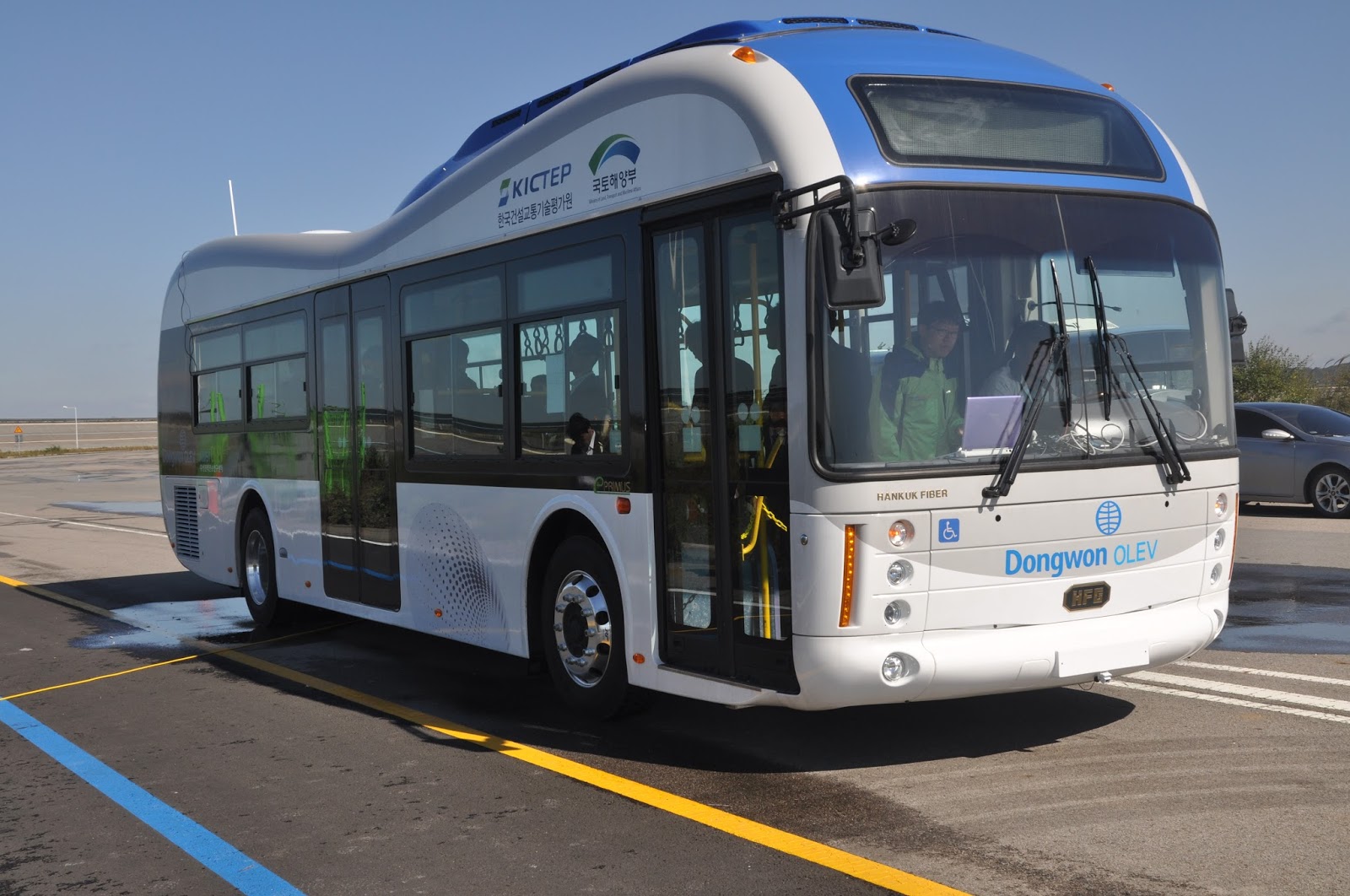
Two cordless rechargeable Hyundai battery electric buses have been put in service this week in a pilot program in Gumi, South Korea.

The Online Electric Vehicle (OLEV), developed by the Korea Advanced Institute of Science and Technology (KAIST), is an electric vehicle that can be charged while stationary or driving, thus removing the need to stop at a charging station. Likewise, an OLEV tram does not require pantographs to feed power from electric wires strung above the tram route.

Two OLEV buses will run an inner city route between Gumi Train Station and In-dong district, for a total of 24 km roundtrip. The bus will receive 20 kHz and 100 kW (136 horsepower) electricity at an 85% maximum power transmission efficiency rate while maintaining a 17cm air gap between the underbody of the vehicle and the road surface.

OLEV is a groundbreaking technology that accelerates the development of purely electric vehicles as a viable option for future transportation systems, be they personal vehicles or public transit. This is accomplished by solving technological issues that limit the commercialization of electric vehicles such as price, weight, volume, driving distance, and lack of charging infrastructure.

OLEV receives power wirelessly through the application of the "Shaped Magnetic Field in Resonance (SMFIR)" technology. SMFIR is a new technology introduced by KAIST that enables electric vehicles to transfer electricity wirelessly from the road surface while moving.

Power comes from the electrical cables buried under the surface of the road, creating magnetic fields. There is a receiving device installed on the underbody of the OLEV that converts these fields into electricity. The length of power strips installed under the road is generally 5%-15% of the entire road, requiring only a few sections of the road to be rebuilt with the embedded cables.

OLEV has a small battery (one-third of the size of the battery equipped with a regular electric car). The vehicle complies with the international electromagnetic fields (EMF) standards of 62.5 mG, within the margin of safety level necessary for human health.

The road has a smart function as well, to distinguish OLEV buses from regular cars—the segment technology is employed to control the power supply by switching on the power strip when OLEV buses pass along, but switching it off for other vehicles, thereby preventing EMF exposure and standby power consumption. As of today, the SMFIR technology supplies 60 kHz and 180 kW of power remotely to transport vehicles at a stable, constant rate.

After the successful operation of the two OLEV buses by the end of this year, Gumi City plans to provide ten more such buses by 2015.

Sunday, July 7, 2013

Oak Ridge Lab to develop dynamic wireless EV charging

South Carolina’s leading automotive research center and premier technology and aviation business park have partnered to study next-generation vehicle technology.

The Clemson University International Center for Automotive Research (CU-ICAR) and the S.C. Technology Aviation Center (SCTAC) have contracted with Oak Ridge National Laboratory to support a three-year program to develop and test wireless charging systems for electrical vehicles.

The research is funded by the U.S. Department of Energy.

Wireless Power Transfer Charging (WPTC) of an electric vehicle does not require the use of cables or plugs and could substantially increase convenience — and possibly the number of opportunities — to charge an electric vehicle throughout the daily drive.

For instance, when wireless charging is applied in quasi-dynamic (stop-and-go) or dynamic (vehicle-in-motion) modes, the technology could lead to extended range and downsized batteries for electric vehicles. Such innovations are likely to greatly speed development of electric-powered passenger vehicles by addressing the current technology’s two biggest challenges: range and cost.

CU-ICAR research professor Joachim Taiber, who will lead the project for Clemson, said batteries in next-generation electric-powered vehicles can be made smaller and lighter, greatly increasing the efficiency of power transfer.

“This partnership can advance wireless-charging technology and spark growth in the marketplace because consumers will worry less about range-related issues,” Taiber said.

As part of the project, CU-ICAR and SCTAC researchers will validate the Oak Ridge-developed technology, optimize system design and develop the required communication networks for the wireless charging system.

Testing of the technology will take place at SCTAC and on the Oak Ridge main campus. SCTAC will be a unique, cutting-edge technology demonstration facility and airpark, which currently is home to 85 diverse companies with an international presence in advanced manufacturing, trade, technology and avionics.

“This joint initiative marks the next step in the progression of our strategic partnership with CU-ICAR and multiple private stakeholders in the development of a world-class test track infrastructure to support the rapidly emerging clean transportation ecosystem,” said Jody Bryson, SCTAC president and chief executive officer.

The Oak Ridge National Laboratory charging system will be co-developed and manufactured by Wytheville, Va.-based Evatran. Other project partners include General Motors, Toyota, Duke Energy and Cisco. The value of the subcontract for Clemson University is $1.52 million.